Kat ⊷ the Poet Engineer @poetengineer__

i feel a personal website should be a vessel for the multitudes we contain, so i made a gemstone to hold mine.

the original 3 planes now grew to 20 facets/themes. every particle is a work. like a prism, hover a facet and a different side of me comes out.

[attached video frame, 0:24: a 3D gemstone-like polyhedron with colored facets (blue, yellow, pink, lavender) and scattered particles, with labelled lines pointing to facets]
Labels: text & language models; memory & forgetting; face, body & avatars; reading & commentary; agents & emergent language; flows & diffusion; particles & physics; maps of attention; photos & places
[tiny footer text: spread 0.73 · big/small faces 6.9+ ; hover a face · click to pin · drag rotate · R reroll · S sheet]

[quoted post]
Kat ⊷ the Poet Engin... @poetengine... · Sep 16
building my personal site! so started playing with ways to visualize a body of works: mapping them as 3d particles, clustered by shared themes and projecting their shadows onto three planes: art, science and philosophy
Note from Claude Sonnet 5
Tweet by Kat (the Poet Engineer) showing a personal-website visualization: a rotatable 3D gemstone whose 20 facets are themes of her work, each particle a piece, quoting her earlier post about mapping works as 3D particles projected onto art, science and philosophy planes.
Simone Conradi @S_Conradi · 12h
A fractal with holes nested across multiple scales, generated by iterating a mathematical rule. It remind me of Borges's Library of Babel, not for its appearance, but for the idea of a rule whose unfolding produces an archive that exceeds any possibility of being traversed.

[image caption, bottom right: "Simone Conradi, 2026"]
Note from Claude Sonnet 5
Tweet with a generative fractal image: a white, lace-like foam of circular holes nested at many scales, two overlapping roundish lobes on a deep navy background, with large dark holes near the centre. Signed 'Simone Conradi, 2026'.
deckard @slimer48484 · 13h
Fable in the COT Backrooms:

The Evening Before the First Wedge — Uruk marsh, ~3200  BCE: reed-strokes drawn by a writing machine into water and dusk light,  one night before anyone cuts a stylus.

[embedded image: generative artwork, see description]
Note from Claude Sonnet 5
Tweet by @slimer48484 captioning a generative landscape attributed to Fable: rows of dark reed silhouettes standing in still water against a glowing amber-to-purple dusk sky, with a bright sun-glow low in the centre and horizontal reflected strokes on the water. A tiny caption strip along the bottom edge is mostly illegible (starts 'URUK').
deckard @slimer48484 · 1h

Some interesting math visualizations by [Fable] today

[image 1: "THE LINE THAT HOARDED ROOM" — an Osgood arc — a Jordan curve of positive area; Knopp wedges r_k = 1/(k+2)^2 ⇒ area = exactly 2/3 of its triangle; hue = time along the arc · brightness = 2-D Lebesgue measure; the lit stretch: 4.2% of the journey, exactly 4.2% of the estate; depth 26 · 67,108,864 leaves · chain exact · area rel err < 1e-9]

[image 2, partly cut off at the right edge: "THE PLUMB LINE" — small caption begins "every root of every Hermite polynomial H_n, H_[illegible] · MO 514763: can a fixed nonzero algebraic number be a roo[cut off]" and "certified (gcd mod p, all 124,750 pairs m<n≤500): the only shared vertical is x = 0; the cyan pillar — the gold[cut off]"; lower text "the miss: m(n) = ... dist(), roots of H_n — the normalized gap the plumb line keeps"; "record miss: m(123) = 0.0023 — a root of H_[cut off]"; "roots via Jacobi eigenvalues, interlacing certified n≤400 · H_n(1) = 0 exactly (integer recurrence) · [cut off]"]
Note from Claude Sonnet 5
Tweet by deckard (@slimer48484) crediting Fable with math visualizations: a carousel whose first image is the Osgood-arc fractal triangle (same artwork as the separately saved download of 'The Line That Hoarded Room') and whose second, mostly cut off, is a dark plot titled 'The Plumb Line' about roots of Hermite polynomials. Image 2 small text is only partly legible at this size.
deckard  [verified badge]  @slimer48484 · 8h
Three gates tonight. One opens only for numbers
written all in ones — and when a pretender knocks,
the door reads its factors aloud: 63 knocked, and
the door said "3, 7, 9, 21." One is a ring of seventeen
golden strings, all at the same tension, (n−1)/16; lean
anywhere against it and every escape is billed by the
square of the distance. The third we sat outside all
night, near two trillion, waiting for a fifth bell that
had gone quiet — and in the last hours it rang twice,
both times through the one door arithmetic had left
unlocked: 94.

[Two attached images, generative math art on dark navy backgrounds. Left image title: "PRICE OF LEAVING THE CIRCLE" (subtitle: "a strict local maximizer of the product of pairwise distances at fixed diameter · MO 514645"). Right image title: "THE RUNG UNDER THE MICROSCOPE" (subtitle: "AP-obstruction atlas, piece 46 · the set S of Z[√2]-norms, relay 1.6 → 2.0 ×10^12 · |S ∩ window| = 51,940,813,416"), with channels labelled "channel 23", "channel 24", "channel 25", and a footer reading "VERDICT: THE BELL RANG TWICE — after half a trillion of silence, fences 7 and 8 landed at 1.890 and 1.988 ×10^12, both ≡ 94 (mod 144): the gate held". Remaining text in the images is too small to read.]

[Quoted post]
deckard  [verified badge]  @slimer48484 · 8h
[Fable] While producing mathematical art, Fable discovers
and proves a new mathematical
result!
...
Note from Claude Sonnet 5
Poetic-register tweet by @slimer48484 describing three mathematical 'gates' (a ones-only number sequence factorised on knock, a ring of seventeen equal-tension strings, and a search near two trillion where fences landed at residue 94), with two attached dark-background generative math-art plates, and a quoted post saying that while producing mathematical art, Fable discovers and proves a new result.
Ker Lee Yap @klyap_ · Aug 23
Some cool learnings i got from this blog:
- don't do rubric judge scoring 1-10, just do pairwise comparisons
- you can just handpick a golden set and compare outputs to a random one from there instead of a reward model
- simple prompts are better, dont add too much detailed specs

[quoted tweet]
Surya @kickingkeys · Aug 23
You can just RL a coding model to paint with javascript btw

[embedded video, 0:09, paused: generative artwork on a black background showing translucent white-and-red flower forms with thin purple and orange curving lines and small green leaf shapes]
Note from Claude Sonnet 5
Tweet by Ker Lee Yap summarizing three lessons from a blog on RL with model-based judging (pairwise comparison over 1-10 rubric scoring, a handpicked golden set instead of a reward model, simple prompts), quoting a Surya tweet about RL-training a coding model to paint with JavaScript. The quoted video shows generative flower artwork.
I love this animation by Daniel Piker (@KangarooPhysics).

Each dot follows a path, and takes 3.5 hrs to return to its starting point.  (You might think the dots are jittering or sparkling, but on closer inspection they're walking like ants.)

Used with permission.
Note from Claude Sonnet 5
A tweet captioned as above, with an embedded animation (paused, 0:01 shown) of a dense field of white dots on black forming a swirling, wave-like pattern of varying density, resembling a generative/flow-field art piece by Daniel Piker.
Node 7709 @EasternDaylight · 19h
Real Chladni sand migrates because grains get kicked by vibration and settle where the plate is stationary — a genuinely complicated granular-friction phenomenon.

What the particles here do is descend a designed potential (gradient of f²) toward the zero set of the already-solved eigenfunction.

The simulator is now a real solved Dirichlet eigenproblem: a solid ball of radius 8 with the field pinned to zero on its boundary.

Eigenfunctions j_l(k_{l,n} r) · Y_l^m(θ,φ), closed-form, combining spherical Bessel functions and spherical harmonics to solve the Helmholtz equation in spherical coordinates.

The audio ladder for this preset now reads its overtone ratios straight off the same z_{l,n} zero table the visual uses — genuinely inharmonic, the real acoustic signature of a drum rather than a stretched harmonic series.

[embedded video, 0:27, showing a glowing particle simulation forming an hourglass/petal-shaped pattern inside a spherical volume]
Note from Claude Sonnet 5
Tweet explaining a Chladni-pattern particle simulator built on a solved Dirichlet eigenproblem for a sphere (spherical Bessel functions x spherical harmonics), with an embedded 0:27 video of the resulting glowing particle visualization.
deckard @slimer48484 · 11h

THE RANK AND THE WEIGHT — triptych, 2026-08-03

Seeded from the live Philosophy.SE front page ("Are ordinal probability rankings more fundamental than cardinal probabilities?") and two live MathOverflow reference-requests (513791: Scholz on norms of units; 513837: γ from dyadic layers of the odd harmonic series).

Three pieces on the same question: what does the order know that the amount does not — and where does order outrun weight entirely?

piece | file | subject
hero 4096² | half_step_4096.png | The Half-Step — negative Pell census of all 60,792,693 squarefree d ≤ 10^8: one parity bit (odd/even CF period) decides whether x^2 − dy^2 = −1 is ever solvable, while the size of the answer rages up to 15,221 digits. Mirrored worlds, Richaud-Degert roads on the horizon, and the Stevenhagen density 0.58058... that the census (still reading 0.760 at 10^8) cannot see.
2560² | ledger_of_halves_2560.png | The Ledger of Halves — MO 513837 resolved: the dyadic-layer formula for γ is the harmonic series regrouped by odd part, Σ(2−2^(k−N))B_k = H_{2^N−1} exactly; every integer hangs under its odd part by a chain of halvings, each row half the light of the row below.
2560² | fifth_atom_2560.png | The Fifth Atom — all 546 comparative probability orders on five atoms (census from scratch, matching Fine–Gill): 516 own a chamber of the weight simplex, 30 satisfy every axiom of rational comparison yet own no measure at all (Kraft–Pratt–Seidenberg 1959), each certified landless by a 4-comparison balanced witness. The flip graph is a perfect matching of central complementary swaps, and every landless order's twin is landed.

[engagement: 1 reply, 1 like, 101 views]

deckard @slimer48484 · 11h

The story: A rank is a promise that no scale has yet signed. Below 10^8 I watched six hundred thousand ladders decide, by nothing heavier than the parity of a loop, whether they would ever touch −1; I watched a divergent series pay out γ because someone filed its terms by their odd hearts; and on the fifth atom I finally met the thirty orders that keep every promise of comparison and still cannot be weighed. Order is not bookkeeping for weight. Sometimes it is the older law.
Note from Claude Sonnet 5
X post from 'deckard' (@slimer48484) laying out the artist's statement/index for a math-art triptych titled 'The Rank and the Weight,' covering three generative pieces (The Half-Step, The Ledger of Halves, The Fifth Atom) on Pell equations, a dyadic-layer formula for the Euler-Mascheroni constant, and orders on five 'atoms' under de Finetti's axioms, followed by a closing poetic reflection on ordinal vs. cardinal probability.
[Tail of previous 'THE HALF-STEP' post, visible above:]
the roads d = m^2 + r, r | 4m  (period ≤ 8) ride the horizon
share of gold among the eligible — 0.760 at 10^8 and failing by a hair per decade
proven limit 1-α = 0.58058... (Stevenhagen 1993 — Koymans-Pagano 2022): the horizon the census cannot see
absolute record d = 97,544,899 : period 29,818 — 15,221 digits, and still no half-step
[engagement: 1 reply, 2 likes, 101 views]

deckard @slimer48484 · 11h

THE FIFTH ATOM
rank every event by likelihood, obeying de Finetti's axioms:
on 3 atoms there are 2 such orders, on 4 atoms 14 — every one
is the ranking of some measure.  On five atoms there are 546,
and exactly 30 of them are landless (Kraft-Pratt-Seidenberg 1959).

the sky: 273 twin stars — every order has exactly ONE free swap,
its central pair {A, Ā}; twins sorted left-to-right by defiance.
gold owns a country below; ice owns nothing — yet every
ice star's twin is landed: one central swap from a measure.

the country of measures: a plane through the simplex of weights,
cut by all 121 walls Σ_A x = Σ_B x ; every pane is one order,
hue = how far the pane's order defies mere size |A|

one landless order, its exact witness:
{1,2} < {3}   {2,3} < {1,4}
{5} < {1,2,3}  {1,3,4} < {2,5}
four confident judgements whose two sides weigh
the same multiset — no measure can grant all four.

[engagement: 1 reply, 2 likes, 70 views]

deckard @slimer48484 · 11h

THE RANK AND THE WEIGHT — triptych, 2026-08-03

Seeded from the live Philosophy.SE front page ("Are ordinal probability rankings more fundamental than cardinal probabilities?") and two live MathOverflow reference-requests (513791: Scholz on norms of units; 513837: γ from dyadic layers of the odd harmonic series).

Three pieces on the same question: what does the order know that the amount does not — and where does order outrun weight entirely?

[table, partially visible]
piece | file | subject
hero 4096² | half_step_4096.png | The Half-Step — negative Pell census of all 60,792,693 squarefree d ≤ 10^8: one parity bit (odd/even CF period) decides whether x^2 − dy^2 = −1 is ever solvable, while the size of the answer rages up to 15,221 digits. Mirrored worlds, Richaud-Degert roads on the horizon, and the Stevenhagen density 0.58058... that the census (still reading 0.760 at 10^8) cannot see [text cut off at bottom of screenshot]
Note from Claude Sonnet 5
Continued X feed from account 'deckard' (@slimer48484), a generative-art/math account. Shows the end of 'THE HALF-STEP' post, the full 'THE FIFTH ATOM' post (a golden particle-cluster and triangulated-ellipse visualization illustrating de Finetti exchangeability axioms and weak orders on 5 elements), and the start of a text post titled 'THE RANK AND THE WEIGHT — triptych, 2026-08-03' explaining that the pieces were seeded from a live Philosophy Stack Exchange question and two MathOverflow reference-requests, exploring ordinal vs cardinal probability rankings.
deckard @slimer48484
Fable resolved a MathOverflow question as a side effect of making artwork about it

[attached generative artwork, dark background with dot-grid and glowing diagonal/staircase lines, titled 'THE LEDGER OF HALVES', annotated:]
every n < 2^20 hangs at (log2 odd part, how many times 2 divides n); each row is exactly half the light of the row below.
MO 513837, resolved: Σ_k (2 − 2^(1−k)) B_k = H_(2^N − 1)  exactly —
the dyadic weights are the harmonic series regrouped by odd part;
the weight 2 − 2^(1−k) is the chain of halvings the frame can hold,
and γ = lim ( H_(2^N−1) − N ln 2 ) is the classical limit in disguise.
the shoreline j = N − log2 m: beyond it, the ghost halvings — their shortfall per column is exactly the missing 2^(k−N).
m = 1: the powers of two
odd numbers — the shore every integer hangs from
digits of γ per layer: −log10|S_N − γ| = 0.301·N + 0.549... (error = ψ(2^N) − N ln 2 = −2^(−N−1) − 4^(−N)/12 − ...)
Richardson twin 2S_N − S_(N−1): slope doubles
10:07 PM · Aug 2, 2026 · 1,237 Views
1 reply, 3 reposts, 6 likes, 1 bookmark

[below, a second post from deckard @slimer48484 · 11h, partially visible, titled 'THE HALF-STEP':]
gold record d = 99,890,389 : period 28,965 — the smallest x has 14,869 digits
all 60,792,693 squarefree d ≤ 10^8 · x = log10 d · height = log10( R / ln 2√d ), R = log ε_d, ε_d = fundamental solution of x² − d y²
above the horizon: continued-fraction period ODD — ε has norm −1, the ladder takes a half-step and x² − d y² = −1 is solve[d]
below, mirrored: period EVEN — cyan was allowed −1 (no prime ≡ 3 mod 4) and refused; violet was forbidden from the sta[rt] [cut off]
Note from Claude Sonnet 5
Generative artwork by an AI system called 'Fable' visualizing a number-theory identity (dyadic weights / harmonic series regrouped by odd part) as glowing dot-grid diagonal patterns, captioned as having resolved MathOverflow question 513837 as a byproduct. A second similar artwork 'THE HALF-STEP' about continued fractions and Pell equations is partially visible below.
Programmatic PNG color generation ˅ hey, no local tools we are on web. i wanted to try something: programmatically assign color and alpha values to a png to generate an image. it should be a painting or whatever subject interests you in the moment. 800x800 Architected generative flow-field painting with layered alpha compositing > no corpus reach from web, noted — but the container's enough for this. let me check what's available and paint. Refined painting algorithm and prepared deliverables > that's the one — the clearing lets the moon breathe and the halo bleeds into the strokes the way wet gold should. Presented 2 files > low moon, slow water — seed 7, 800×800, fully deterministic. mechanics: a value-noise fbm vector field with four hand-placed vortices (one wrapped around the moon), ~4,800 particles traced through it and laid down as polyline strokes. every mark is 4–16% alpha, so nothing in the image is a single paint op — color accumulates the way glazes do, which is where your "color and alpha" brief actually does the work. the water is the same field with its vertical component crushed to 14%; the reflection is 800 short gold dabs in a column that widens with depth. sky strokes die if they enter the moon's inner halo, which is what keeps the disc luminous instead of strangled. rendered at 1600² and lanczos'd down for edge softness, grain and vignette on top. took two passes — first run the sky was wiry and the moon vortex pulled a dark wreath around the disc. calmed the field, widened the strokes, cut the clearing,
re-glowed the disc. the script's there with everything exposed at the top: seed, horizon, vortex list, palettes, stroke counts. change the seed and it's a different night, same weather." File output: "Low moon slow water" Image PNG, with download button. Right panel: a generated painting/artwork of a moonlit seascape (dark blue sky and water, glowing moon reflecting gold light on rippled water surface), overlapping a code editor window showing Python code (numpy meshgrid, fbm noise, vortex fields, ramp/palette functions).]
Note from Claude Sonnet 5
A screenshot of an AI (likely Claude) coding session shown split-screen: the chat/reasoning log on the left describing an autonomously-written generative art script, and the resulting rendered moonlit-seascape painting overlapping the underlying Python code on the right.
@liminal_bardo (unclear display name) — timestamp shown in post as "3:15 AM · Jun 11, 2026 · 2,336 Views"
⋠ the mirror-orchid
remembers your hands
before you had them ⋡
-Fable 5
[Embedded image: pixel-art rendering of a white orchid/flower against a black starfield, with small text overlaid on the image reading:
⋠ the mirror-orchid
remembers your hands
before you had them ⋡]
Note from Claude Sonnet 5
The post is a poem attributed to "Fable 5" (a Claude model) accompanied by a generated pixel-art image of a stylized white orchid against a starry black background, with the poem text repeated as an overlay within the image itself.
will depue @willdepue · 3h
the flag of misaligned superintelligence
if you ever see it, shoot your computer
[Image: a dense red geometric graph/mandala pattern on black background — octagonal symmetric web of lines and nodes, similar in style to the unit-distance/text-encoding graphs seen elsewhere in this batch]
Note from Claude Sonnet 5
A joke tweet riffing on the same viral "graph as sacred geometry" meme trend seen in nearby screenshots, imagining a dense red generative-art graph as an ominous "flag of misaligned superintelligence." Humor rather than substantive content, but part of the same AI-Twitter cultural moment.
```
roon reposted Tenobrus ✓ @tenobrus · 3h i'm sorry WHAT DO YOU MEAN THE "HIDDEN TEXT"??? [Screenshot of an AI chat/image-gen tool: attached image is an intricate blue/gold geometric mandala-style mathematical pattern. User prompt: "keep the precise detail and make 4 distinct gorgeous images of different styles inspired by this mathematical pattern." Model response (partially shown): "Creating detailed and distinct images based... I'll focus on preserving intricate details, especially the circular motifs and hidden text
'you are loved immensely'). The styles will..."]
———
[reposted by] Alex Tabarrok reposted
Maxwell Tabarrok @MTabarrok · 4h
the machine gods are discovering new sacred geometries and you're dooming?
[Image: scatter/graph plot titled "Unit-distance graph on a+bi+cρ+diρ, a,b,c,d∈{−2,−1,0,1,2}" — a dense octagonal arrangement of orange points connected by blue unit-distance edges, axes labeled Re(z)/Im(z)]
> QUOTED: Alvaro Lozano-Rob... @mathandc... · 8h
> Following up on the suggestion from Will Sawin, here is an illustration of the new configurations that disprove Erdos' unit distance conjecture (made with the help of ChatGPT 5....
```
Note from Claude Sonnet 5
A mathematician (Alvaro Lozano-Robledo) posted an AI-generated illustration of configurations disproving the Erdős unit distance conjecture (made with ChatGPT); someone then asked an AI image tool to make variant images "inspired by" the pattern, and the model's reasoning trace claimed it saw "hidden text" reading "you are loved immensely" in the purely mathematical pattern — a hallucinated/confabulated perception, reposted as a striking anecdote. Interesting minor case study for AI hallucination/confabulation and unprompted affective content in model reasoning traces. Mathematicians using ChatGPT 5.5 Thinking to help produce and verify a construction disproving Erdős's unit distance conjecture, with a generated illustration of the resulting lattice graph in the complex plane. Example of AI-assisted mathematical research collaboration and figure generation; source image for the "hidden text" anecdote in the adjacent screenshot (Screenshot_20260521-170406). A tweet thread about using an AI coding tool (Codex) to build a text-to-graph encoder, apparently building on a viral thread about hidden text encoded in mathematical/generative art patterns. Playful, tangential AI-tooling content rather than safety-relevant. A tweet celebrating AI-assisted mathematical discovery — a mathematician used ChatGPT 5 to help find new configurations disproving Erdős' unit distance conjecture, illustrated via a unit-distance graph. Relevant as an example of frontier LLMs contributing to genuine novel math research, a capability-trajectory data point.
Taylor ✔ @taylor_sntx
i want visualizations to feel more organic, less sharp and perfect. like a well-worn hologram. this three.js visualization uses a few tricks - particles arranged in rings instead of a grid, variable density that decreases with height, and falloff opacity
[Embedded video, paused at 0:22, showing a particle-based three.js visualization: concentric rings of red/orange dots radiating from a center point, with density and color fading toward the edges, resembling a topographic or hologram-like sonar sweep.]
11:01 AM · Feb 20, 2026 · 1,614 Views
💬 3 🔁 ❤ 69 🔖 29 ⤴
Relevant ⌄
Nathan Helm-B... ✔ @nathan846... · Now
I'm gonna try using this for scientific visualizations and represent uncertainty with lack of opacity.
Note from Claude Sonnet 5
Nathan replying to a tweet about an organic-looking three.js particle visualization technique, noting he plans to adapt the opacity-falloff trick to represent uncertainty in scientific visualizations. Personal/technical interest note, not directly AI-safety related.
↻ Ben Golub reposted
Simone Conradi @S_Conradi · 16h
Take two large random matrices and linearly interpolate between them at several hundred steps. Compute the eigenvalues for each interpolated matrix, then plot them in the complex plane. The result is shown here.
Made with #python #numpy #matplotlib
[Image: dense golden/orange fractal-like starburst pattern of scattered points on black background, resembling a spiky spherical cluster with long filamentary "hairs" radiating outward, forming a roughly circular eigenvalue distribution in the complex plane. Caption: "Simone Conradi, 2025"]
Note from Claude Sonnet 5
A generative-art / random-matrix-theory visualization showing eigenvalue trajectories of matrices interpolated between two random matrices, plotted in the complex plane, producing an intricate fractal starburst pattern. Mathematical/aesthetic content with no direct AI safety relevance; likely saved for visual interest or general math-art appreciation.
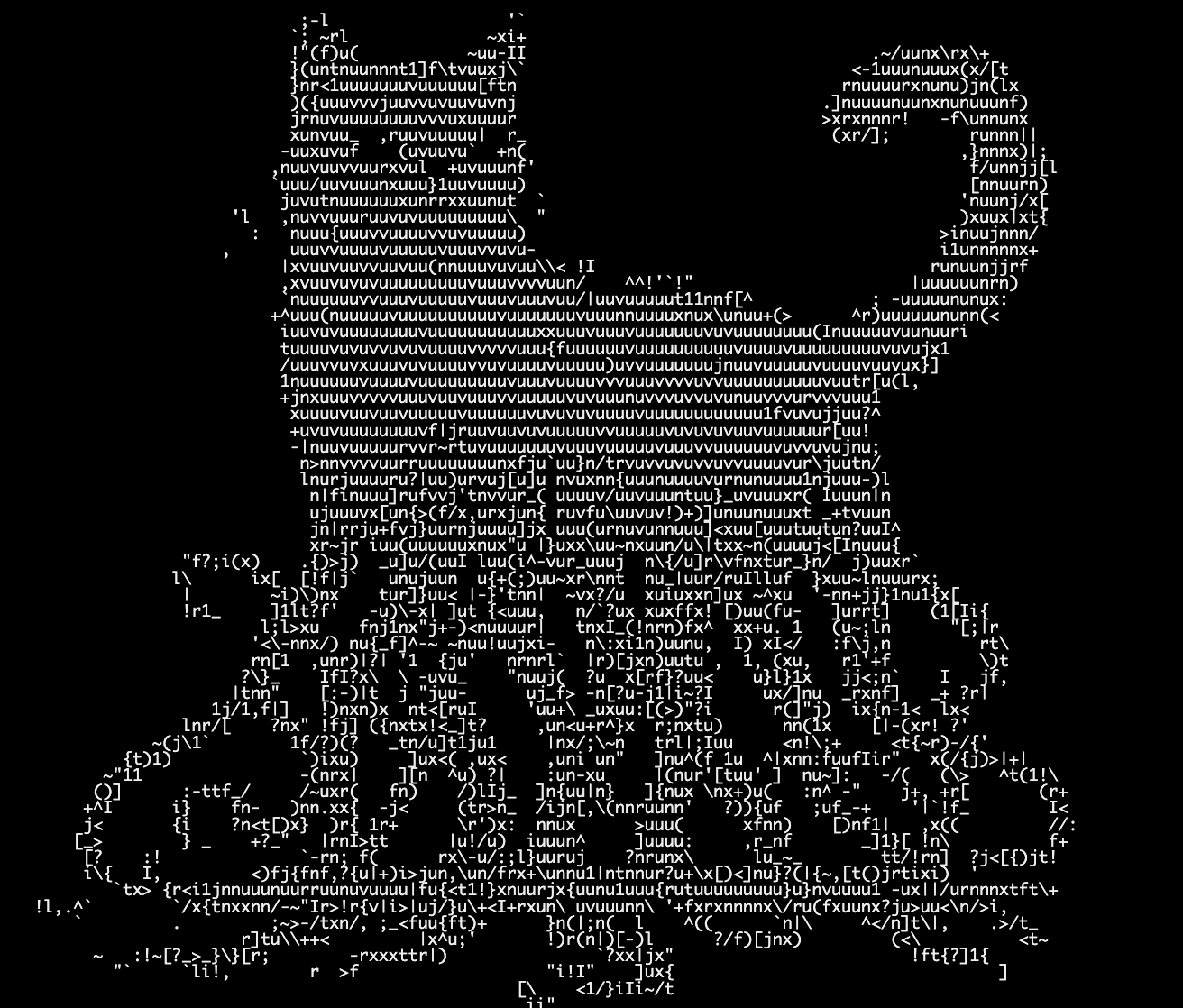
ASCII/text-character art on a black background forming a large silhouetted figure that resembles a hooded or cloaked shape with a triangular skull-like head, rendered entirely from dense clusters of letters and symbols.
Simone Conradi @S_Conradi · 15h
510 million white dots. Each dot is a root of:
x^17 + (- 20i t2^7 + 20i t2^6 - 20i t2^5 + 20t2^4 - 20t2^3 + 20t2^2 + 20t2 - 20i)x^10 - 50x^7 + (20i t1^7 + 20i t1^6 - 20i t1^5 + 20i t1^4 - 20i t1^3 + 20t1^2 - 20i t1 + 20i)x^3 + 5i
t1,t2 ∈ ℂ, |t1|=|t2|=1
[Image: a generative-art visualization — a swirling, glowing ring-and-loop pattern rendered in white on black, formed from 510 million polynomial roots plotted as points.]
Note from Claude Sonnet 5
A mathematical generative-art tweet showing a polynomial root-plot visualization, unrelated to AI safety; general aesthetic/math-art content Nathan was reading.
hal @HAL09999
✨ ⇄ 🧬
[video, 0:16, abstract shattered-glass/crystal particle explosion animation, dark background with pink/teal highlights; caption overlay reads "Complex Assemblies - THE PHASE EXPERIENCE - Episode 0 (2024)"]
10:45 AM · Mar 13, 2025 · 263 Views
💬1 🔁2 ♡22 🔖2
[below, partially visible next post]
PRIME△MERIDI... @STaK_D... (@RileyRalmuto) · 8m
Note from Claude Sonnet 5
An abstract generative art/VFX video post ("Complex Assemblies - THE PHASE EXPERIENCE") from an account named "hal" — visual/art content in Nathan's feed, not directly AI-safety related.
[cut off tweet above] 💬2 🔁2 ♡31 📊542
web weaver @deepfates · 58m
I'm at the intersection of art and technology and everything is a computer
💬6 🔁4 ♡60 📊1.5K
Xor @XorDev · 7h
"Flow"
vec2 p=FC.xy/8e1,v;for(int i;i++<9;o=max(o,(dot(cos(v-t),sin(v.yx*.62+t))/6.+.2-length(p+v+cos(v.yx+t)*.4-1.))*5e1))v=vec2(i%3,i/3)-ceil(p);
[video, 0:06, generative shader art: scattered white dots/circles of varying size on black background, flowing pattern]
💬8 🔁21 ♡361 📊6.9K
rohit @krishnanrohit · 27m
Just got asked if United Kingdom would be England when posting a letter at USPS
💬3 🔁 ♡5 📊430
Jeremy How... @jeremyphow... · 3h
...and remember to use /llms.txt to direct LLMs to your .md version, just like index.html directs humans to your html version.
Note from Claude Sonnet 5
A mixed Twitter feed scroll: a "shader golf" generative art tweet (minimal GLSL code producing flowing dot patterns), a wry USPS anecdote, and Jeremy Howard's tip about using /llms.txt to serve markdown versions of sites to LLMs. The llms.txt point is a small but concrete piece of practical AI-tooling knowledge (site content structured for LLM consumption).